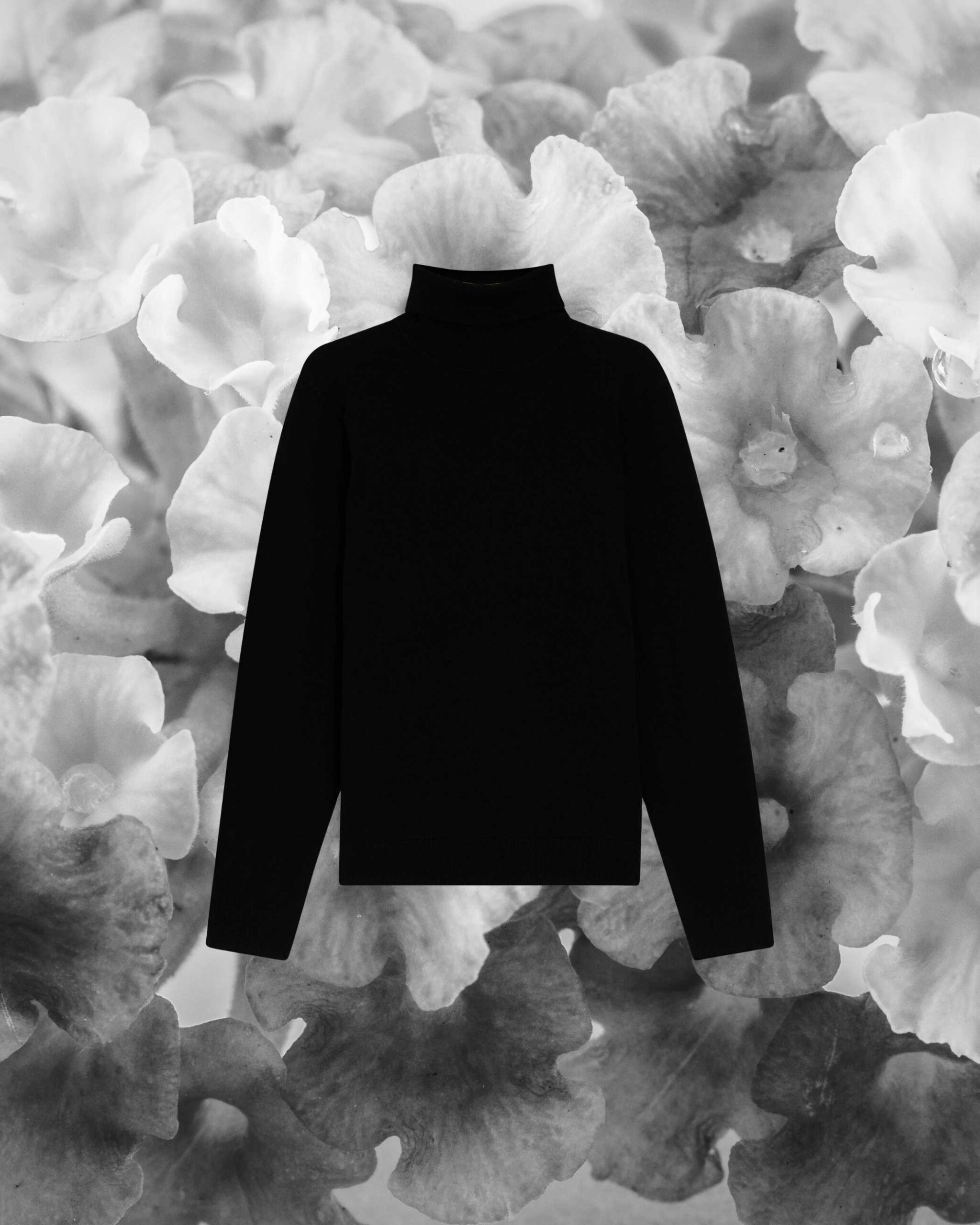
The Eternal Black Turtleneck
The black turtleneck is one of those garments that manages to inhabit multiple worlds at once, its presence recurring with the seasons not because it bends to trend cycles but because it embodies a kind of permanence, the sort of garment that gathers meanings as different cultures, designers, and personalities claim it, until what was once simply practical knitwear has become a language of its own. It is impossible to separate the garment from its history, because every new appearance brings with it the shadow of earlier wearers, and it is precisely this layering of associations that has made the black turtleneck more resilient than almost any other item in the modern wardrobe.
When it emerged as a favored piece among poets, painters, and philosophers in Europe and America, its appeal lay in its ability to replace the rigidity of a collared shirt without sacrificing seriousness, to allow a person to signal intellectual gravity without recourse to the conventions of tailoring, and in smoky cafés from Saint-Germain to Greenwich Village the black turtleneck became a uniform that carried connotations of refusal, not the loud refusal of the protest banner but the quieter assertion that creativity and thought could be worn as identity. Juliette Gréco embodied this spirit, her silhouette etched into the mythology of postwar Paris, and across the Atlantic the Beats pulled it over their heads as they read to one another, confirming that a simple black knit could be a visual shorthand for ideas that resisted the mainstream.
Cinema translated those codes differently, and with Audrey Hepburn in Funny Face the turtleneck moved from the margins into an image of pared-down elegance. On her frame the garment ceased to be oppositional and instead became a study in refinement, its lines emphasizing clarity and poise, its restraint presented not as rebellion but as sophistication. This tension between rejection and chic has remained in the fabric of the turtleneck ever since, because it can convey austerity and allure at the same time, depending on who wears it and how.
In another context entirely, the black turtleneck was adopted by Steve Jobs, who commissioned Issey Miyake to design dozens of them so that he could wear the same garment every day. Here the piece was not about aesthetic expression at all but about efficiency and uniformity, about stripping life of one unnecessary decision in order to concentrate on work, and yet the choice was not neutral since Miyake’s designs already embodied a fusion of technology and sculptural minimalism. The result was a new layer of meaning: the turtleneck as the attire of the innovator, the entrepreneur, the man who preferred to project his energy through ideas rather than clothes, and who nevertheless left a mark on the way the garment is perceived.
Designers have long returned to the turtleneck precisely because it absorbs and reflects these shifting meanings. Yves Saint Laurent used it to soften the strictness of tailoring, Helmut Lang and Jil Sander made it central to their vision of modern purity, and Phoebe Philo placed it under coats and dresses in a way that turned it into the hidden anchor of her wardrobe of intelligent restraint. In Japan, Miyake, Yohji Yamamoto, and Rei Kawakubo showed how its silhouette could serve as a base for experimentation, while in contemporary collections The Row, Prada, and Lemaire treat it as a perennial constant that requires no reinvention. The garment functions as a blank canvas, but unlike a white shirt or a grey jacket, it carries within it an entire history of associations, from radicalism to refinement, so that each new collection is not merely revisiting a knit but conversing with everything it has meant before.
The reason it persists is both functional and symbolic. It frames the face with clarity, elongates the line of the body, and slips beneath outerwear without bulk, but it also carries with it the aura of intellectual life, cinematic chic, and technological innovation. To wear one today is to inherit those references, consciously or not, and perhaps that is why the garment refuses to vanish: it allows the wearer to summon histories without speaking them, to gesture toward sophistication, austerity, or focus without declaring allegiance to any single narrative.
Each autumn, as wardrobes shift and the air cools, the black turtleneck returns not as novelty but as ritual, a garment that does not evolve yet never feels obsolete, reminding us that the most enduring pieces in fashion are those that hold complexity within simplicity, garments that speak with more than one voice while appearing silent.