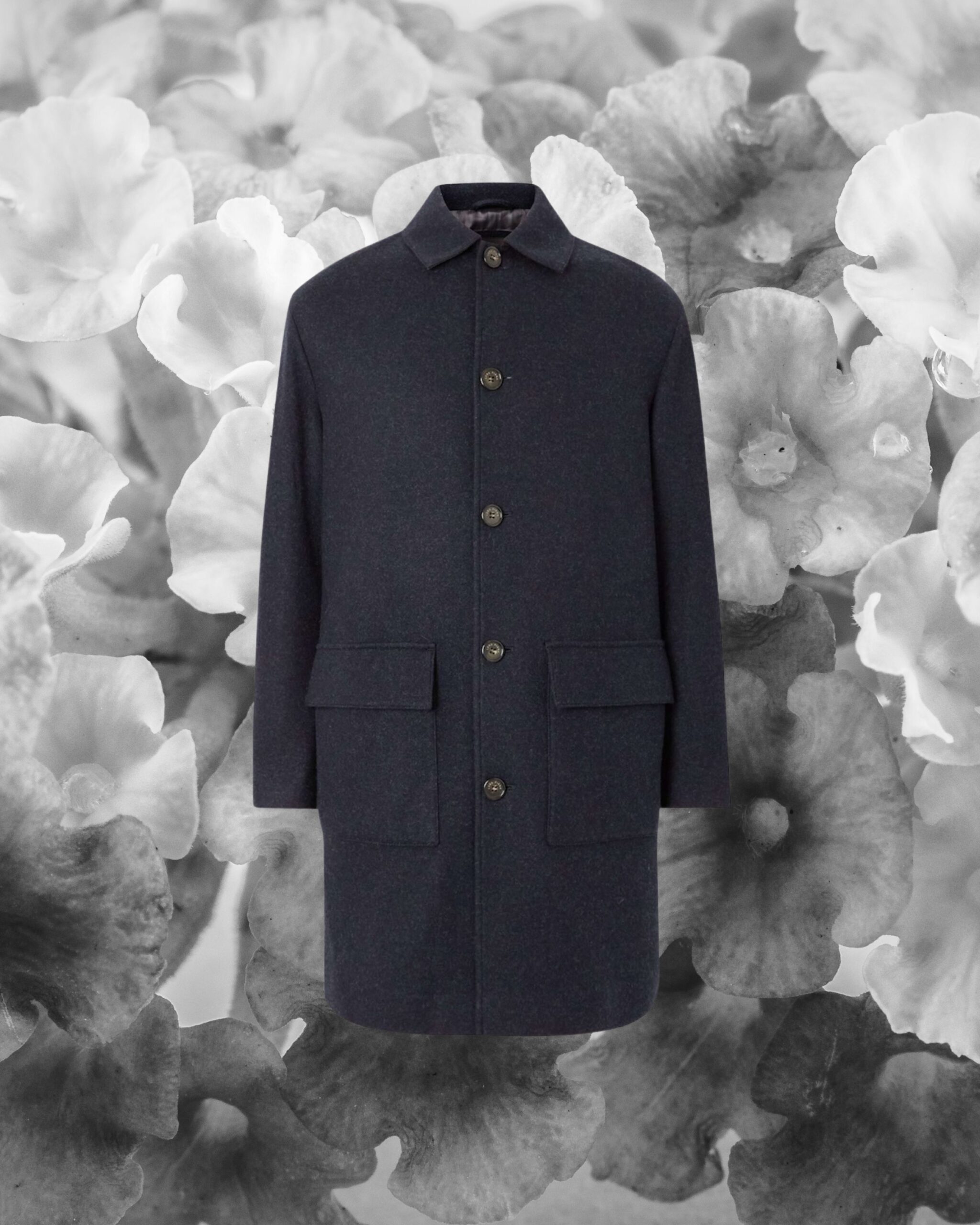
Essential Forms: The Overcoat
Essential Forms is a seasonal series on the garments that form a wardrobe’s foundation. Each article examines construction methods, quality indicators, and the details that distinguish lasting craftsmanship. Whether you’re acquiring a piece for the first time or wish to understand what you already own with greater clarity, these guides offer practical knowledge for any future decision—this season or several years from now.
Fair warning: this article is comprehensive, occasionally to the point of excess. When the goal is understanding rather than quick tips, brevity becomes a limitation. We would rather cover everything once than leave you with questions.
A well-made overcoat has a density you notice the moment you lift it. Not weight, but a compact structure born of tightly woven wool—warm without bulk, wind-resistant without rigidity. As the outermost layer, it defines the silhouette others see, and its authority comes not from fashion but from centuries of functional refinement.
Buttoning an overcoat on a cold morning is a practical act, one rooted in proportion and warmth. The garment endures because it solves a specific problem elegantly: protecting the body from cold while maintaining a clear, structured line over whatever lies beneath.
A History of Function
The overcoat emerged from practical need rather than aesthetic whim. Its origins lie in 18th-century military tailoring—heavy greatcoats designed to shield cavalry and infantry officers from harsh European winters. Extending past the knee, their wide collars could be raised and fastened against freezing winds.
By the 1850s, civilian adaptation had begun. The Chesterfield appeared, named for the sixth Earl of Chesterfield, its velvet collar distinguishing it from purely utilitarian military coats. The Ulster followed in the 1860s, originating in Belfast, with cape and belt engineered for travel and outdoor pursuits in unforgiving weather.
Women’s overcoats developed differently, constrained at first by Victorian dress codes that demanded narrow shoulders and corseted waists. By the early 20th century, as these codes loosened, the overcoat became practical outerwear rather than decorative layering. Designers like Coco Chanel, and later the minimalists of the 1990s, recognized that a well-cut coat could anchor a wardrobe—not through ornamentation but through precision of line and enduring quality.
Across centuries and evolving fashions, one principle remained constant: the coat’s purpose is to maintain warmth without compromising silhouette. This requires deliberate choices in fabric density and construction, marking the overcoat apart from other forms of cold-weather clothing.
The Architecture of Warmth
An overcoat insulates differently from puffers or parkas. Wool fibers are naturally crimped, forming microscopic air pockets when woven densely. The best coating cloths weigh between 16 and 22 ounces per yard—substantial enough to block wind and retain shape, yet light enough for daily wear.
These fabrics originate in mills with long technical histories: Vitale Barberis Canonico in the Italian Alps, Fox Brothers in Somerset, among others. Many use twill weaves for strength and drape, or herringbone for directional interest without compromising structure. The weave matters as much as the fiber—it governs how the cloth falls, breathes, and endures.
“A well-made overcoat performs the same task year after year. Its value lies in consistency: reliable warmth, durable construction, and a silhouette that remains coherent regardless of shifting trends.”
Between cloth and lining lies the interlining—wool batting or flannel—which adds warmth without visible thickness. A well-constructed coat can outperform a heavier one. The lining, ideally silk or cupro, allows the garment to glide over heavier layers while enduring years of wear.
Climate dictates fabric weight and interlining choices. In milder winters—coastal cities, Mediterranean climates, southern regions—a 16 to 18-ounce cloth with minimal interlining provides warmth without discomfort. These lighter coats suit urban life, where you move between heated interiors and brief outdoor exposure.
For harsh winters—northern cities, continental climates—20 to 22-ounce fabrics with substantial interlining are necessary. They provide genuine protection during extended outdoor time, though at the expense of versatility: a coat built for Boston winters will feel heavy in a mild November in San Francisco.
Consider your actual climate and daily routines. If you move primarily between car and building, a lighter coat suffices even in cold regions. If you walk extensively outdoors, weigh warmth heavily. An overcoat is not a parka—it offers structured warmth for urban life, not expedition-grade protection. For extreme cold, layer beneath or acknowledge its limits.
Fabric: Mills and Quality Markers
The finest overcoat fabrics come from mills with generations of technical expertise. Vitale Barberis Canonico, established in 1663 in Biella, Italy, manages the process from raw fleece selection through final weaving. Their wool comes mainly from Australian Merino sheep, chosen for fiber fineness and crimp. Loro Piana operates similarly, controlling quality from sheep breeding through fabric production.
In England, Fox Brothers & Co., founded in 1772 in Somerset, produces dense flannels and tweeds that have clothed British officers and gentlemen for over two centuries. Their fabrics often feel heavier and more substantial than Italian equivalents. Dugdale Bros & Co specializes in coating fabrics dense enough for true cold-weather protection.
These mills primarily use worsted wool—combed to align fibers parallel—producing smoother, more tightly woven fabrics than woolen alternatives. Worsted wool resists wind better and holds shape reliably, though it may feel less soft initially.
Cashmere appears as a luxury addition rather than a replacement. Pure cashmere overcoats exist but are rare and impractical—shorter fibers make pure cashmere less durable under an overcoat’s weight. Instead, quality coats use cashmere blends, typically 10–30% cashmere mixed with wool. This ratio adds softness and warmth without sacrificing structure. Loro Piana and Kiton are known for such blends; anything above 50% cashmere should be approached cautiously—it softens the hand but compromises durability.
Quality markers in the fabric itself: hold it to light. Fine wool is opaque even at 16–18 ounces; inferior fabrics let more light through. Run your hand across the surface: dense, slightly dry wool with subtle texture is ideal. Synthetic blends often feel smoother but slightly slippery or artificial.
The color should be uniform, from selvage to center. Examine the weave: in twill, diagonal ribs should be even and consistent. Irregularities suggest rushed or poorly calibrated weaving.
For Men: Styles and Their Logic
Men’s overcoats fall into three categories, shaped by history more than whim.
- Chesterfield: The most formal, with velvet collar and knee-length cut. Shoulders structured but not heavily padded, accommodating a suit jacket without excess volume. Chest roomed but not billowing. Brioni and Kiton produce exemplary versions with hand-attached collars and precise internal construction.
- Ulster: Longer, more relaxed, with half-belt at the back. Mid-calf length offers maximum coverage, less common today, though specialist makers like Cordings preserve tradition.
- Guard coat: Shorter, knee-length, with fly front and concealed buttons. Adaptable for both business and weekend wear. Ring Jacket and Boglioli produce refined interpretations.
“Quality reveals itself in details that rarely draw attention until they fail.”
Balance between structure and ease is critical. Shoulders must follow the natural line without bulk. The coat should fall continuously from chest to hem. Because it’s often the most visible layer, proportion matters more than decoration.
For Women: Proportion and Line
Women’s coats often use lighter fabrics—12–16 ounces—relying on interlining rather than sheer density. This allows closer cuts without sacrificing insulation. Construction differs pragmatically: women’s coats must accommodate slim knits, structured blazers, and dresses, requiring versatility in cut and drape.
Distinct styles include:
- Classic tailored coat: Notched lapels, defined waist; descended from Balenciaga and Dior; shoulders structured, torso fitted, length creates vertical line. Versatile, formal, refined.
- Wrap coat: Asymmetrical closure with belt; pattern precision maintains clean lines. Max Mara’s 101801 model perfected this in the 1980s.
- Cocoon coat: Loose body, rounded silhouette; relies on weight and expert cutting to avoid shapelessness; popularized by Phoebe Philo at Céline.
Chesterfield influence appears in women’s coats: single-breasted with velvet or grosgrain collar, cut for layering yet structured. The Row produces minimalist examples; Totême favors Scandinavian lines. Loro Piana and Brunello Cucinelli offer cashmere-blend coats where quality is immediately apparent.
Lengths generally range from knee to just below. Collar styles—lapels, stand, shawl—alter character. Balance between shoulder width, lapel size, and overall length ensures flattering proportion. Colors extend beyond navy and camel to deep browns, forest greens, burgundy—anchoring the wardrobe without competing with it.
Reading Quality
Quality emerges in subtle details. Horn buttons have natural striations; mother-of-pearl shimmers with light. Buttons should be sewn with shanks for smooth function. Hand-stitched buttonholes show minor irregularity, machine-made should be reinforced and neat. Seams: 10–12 stitches per inch, small and regular; French seams at stress points; hems and edges carefully finished. Canvas in lapels and chest adds substance, allowing natural roll.
What Betrays Poor Construction
Compromises are visible once you know what to look for. Lightweight fabrics under 14 ounces, often polyester-blended, pill quickly. Polyester linings slip poorly and tear; no interlining compromises warmth.
Polyester between 10–20% is a compromise: some durability, less breathability. Above 20%, fabric loses wool’s temperature regulation, feels clammy, pills, and develops synthetic sheen. Plastic buttons, flat stitching, uneven seams, and pulling across the back are all signs of poor pattern-making—alterations cannot fix these.
How to Buy Well
Start with shoulders—they must sit naturally at your own, seam at the shoulder bone. Chest and waist should accommodate usual layers. Check sleeves, length, and movement. Minor adjustments are possible for sleeves or body, but shoulders cannot be fixed. Prioritize fit where alteration is impossible.
Price tracks fabric and construction. Solid options begin around $400–600 (Spier & Mackay). Mid-tier choices $800–1,500 (Ring Jacket, Boglioli). High-end coats (Loro Piana, Kiton) exceed this, offering exceptional materials and handwork. Improvements are incremental—a $600 coat will perform reliably for a decade. A $3,000 coat is not five times warmer, but refinement is visible to the discerning eye.
The Weight of Constancy
A well-made overcoat performs the same task year after year. Its value lies in consistency: warmth, durable construction, and silhouette coherence.
That density you feel—the compact structure, resistance without rigidity—is the direct result of deliberate choices: wool of the right weight, interlining positioned correctly, seams finished with care, proportions refined through generations. These elements need no reinvention; they solve a timeless problem: how to stay warm while maintaining form.
The overcoat asks only to be chosen well and worn properly. In return, it offers what few garments can—durable performance, season after season, without apology. Button it on a cold morning ten years from now, and it will act exactly as it does today. Not romance, simply the alignment of purpose and construction.