Where to Go for Art This Winter in New York City
Winter in New York means fewer crowds at museums and galleries, making it an ideal time to take in major retrospectives and new work. The colder months traditionally see institutions unveiling their most ambitious programming, and this year is no exception. From German Expressionism to contemporary sculpture, from Chelsea galleries to uptown museums, this season’s offerings span multiple movements and mediums across Manhattan and Brooklyn.
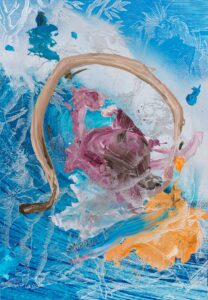
Jeff Koons, Nymph, Pluto, and Satyr, 2018–25, oil on canvas with aluminum leaf, 102 × 71⅛ in. (259.1 × 180.5 cm). © Jeff Koons
Jeff Koons: Porcelain Series
Jeff Koons has been working on his Porcelain series for years, and this is the first time these sculptures get their own show. The pieces look like delicate porcelain figurines—Venus, Diana, deer with dogs, embracing couples—but they’re actually mirror-polished stainless steel with transparent color layered on top. The production involves digital scanning, engineering, and intensive polishing to get that reflective finish. Standing in front of them, you see yourself in the surface, which makes you part of the work whether you want to be or not. The sculptures reference 18th and 19th-century decorative objects while using contemporary manufacturing techniques.
Gagosian, 541 West 24th Street, November 13, 2025 – February 28, 2026
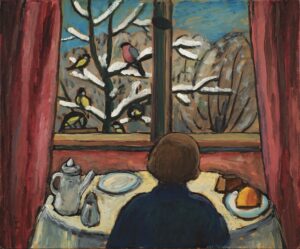
Gabriele Münter: Contours of a World
Gabriele Münter was making radical paintings in early 1900s Germany, but her work often gets less attention than her male contemporaries in the Blue Rider group. This show brings together over fifty paintings that demonstrate how she approached landscape, still life, and portraiture. She wasn’t interested in copying what she saw—instead, she used bold colors and simplified forms to get at something more essential. The exhibition also includes nineteen photographs she took during a two-year stay in America at the turn of the century, showing her eye for composition developed early. Her style shifted depending on where she was living—Germany, Scandinavia, Tunisia—but the commitment to painting everyday life stayed constant.
Solomon R. Guggenheim Museum, November 7, 2025 – April 26, 2026
Ana Mendieta: Back to the Source
Ana Mendieta was born in Cuba, sent to Iowa as a child, and spent much of her career trying to reconnect with the earth and her displaced origins. This exhibition covers 1972 to 1985 and includes ten remastered films, photographs, drawings, and documentation of sculptures that no longer exist. She carved silhouettes into sand and earth, set them on fire, covered them in flowers and blood, then photographed or filmed them before they disappeared. The work deals with ritual, the body, and impermanence. You see her lying in mud filled with red pigment, or a grass-covered mound rising and falling with her breath underneath. The materials were simple—gunpowder, feathers, natural elements—but the gestures were powerful. Mendieta called it going back to the source.
Marian Goodman Gallery, 385 Broadway, November 7, 2025 – January 17, 2026
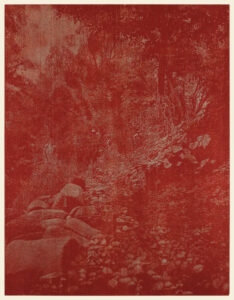
Rüschegg, Untitled, 1988–89, woodcut on Japanese paper, 92⅛ × 71¼ in. (234 × 181 cm). © 2025 Franz Gertsch AG
Franz Gertsch: Presence
Franz Gertsch died in 2022, and this show brings together eight large-scale works that span his career. He worked from photographs but spent months or years rendering them as paintings or woodcuts, getting every detail exact. Two paintings of Patti Smith from 1979 show her performing—you can see individual strands of hair, the texture of her skin, the energy of the moment frozen in paint. A massive triptych of Caribbean forest verges on abstraction because of how densely he packed in the foliage. The woodcuts are technical achievements on their own—Gertsch carved raw wood with custom tools and hand-printed on Japanese paper. He said woodcuts were the worst medium for capturing light, which is probably why he spent decades proving otherwise.
Hauser & Wirth, Wooster Street, November 11, 2025 – January 31, 2026
Faith Ringgold
This is the first exhibition dedicated to Faith Ringgold since she died last year. The show includes her story quilts—painted and quilted fabric pieces with text that tell stories about Black American history and experience. She made textiles, paintings, sculptures, prints, and children’s books over six decades. In the 1960s and 70s, she was painting bold figurative works about race and gender, making posters for the Black Panthers, and organizing protests about the lack of opportunities for women of color in the art world. She founded Where We At, a collective for Black women artists who felt left out of both the male-dominated Black Arts Movement and the white-dominated feminist movement. Her work always had a point to make, and she found different forms to make it.
Jack Shainman Gallery, 46 Lafayette Street, November 14, 2025 – January 24, 2026
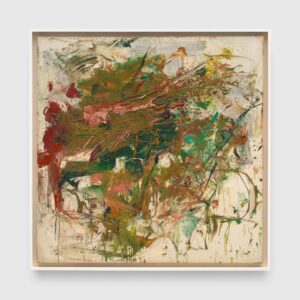
Joan Mitchell, Untitled, c. 1961, oil and charcoal on canvas, 39⅜ × 39⅜ in. (100 × 100 cm). © Estate of Joan Mitchell
Joan Mitchell: To define a feeling, 1960-1965
Joan Mitchell spent summers sailing around the Mediterranean with painter Jean Paul Riopelle during this five-year stretch, and the experience shows up in these paintings. Dark greens and blues swirl in dense masses across the canvases, with other colors buried underneath. She was moving away from the structured compositions of her earlier work and trying something looser, more experimental. The paintings feel turbulent—there’s nothing calm about them. Mitchell once said she was trying to define a feeling, not document her daily life, and these works from the early 60s capture that search. The show focuses tightly on this specific period when she was working between Paris and the coast.
David Zwirner, 20th Street, November 6, 2025 – December 13, 2025
Luc Tuymans: The Fruit Basket
The title painting is huge—sixteen feet tall, twenty-three feet wide, nine panels arranged in a grid. Luc Tuymans photographed a basket of rotting fruit on his iPhone, projected it onto a screen, then painted what he saw, including his own fingers at the edge of the frame. The colors are off, the focus is soft, and the whole thing feels digital even though it’s paint on canvas. Other paintings in the show look like glowing Rothkos until you realize they’re zoomed-in screenshots from a documentary about restoring medieval manuscripts. Tuymans painted thick black borders around them by hand. There are also paintings of 3D-printed figurines of people—an NFL Hall of Famer, a family portrait—rendered in thin, ashy paint so they look like they were never quite alive. The show is about how fractured and mediated everything feels right now, particularly in America.
David Zwirner, 19th Street, November 6, 2025 – December 19, 2025
Wifredo Lam: When I Don’t Sleep, I Dream
This is the first full retrospective of Wilfredo Lam’s work in the United States, which is long overdue. He was born in Cuba in 1902, spent eighteen years in Europe during the Spanish Civil War and World War II, then returned to the Caribbean and completely reimagined what his paintings could do. Lam was of African and Chinese descent, and he pulled from Afro-Caribbean traditions, European modernism, and his own hybrid identity to create work that didn’t fit into existing categories. He called his art an act of decolonization. The exhibition includes over 150 works—paintings, prints, drawings, ceramics—made between the 1920s and 1970s. His figures transform, his landscapes shift, and everything has multiple meanings layered on top of each other.
Museum of Modern Art, November 10, 2025 – March 28, 2026
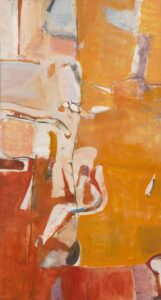
Richard Diebenkorn, Untitled, 1952, oil on canvas, 83½ × 45½ in. (212.1 × 115.6 cm). © 2025 Richard Diebenkorn Foundation/ARS, NY
Richard Diebenkorn
Richard Diebenkorn spent decades in California making paintings that look deceptively simple—geometric blocks of color that somehow feel like light, air, and landscape all at once. This show at Gagosian spans his entire career, from early figurative work influenced by Hopper and Cézanne to the Ocean Park series he’s best known for. Those Ocean Park paintings, made in Santa Monica starting in the late 1960s, break down coastal light and atmosphere into stacked rectangles and diagonal lines. The compositions look effortless but came from months of adjustments, scraping down and repainting until every edge and color felt right. The exhibition includes rarely seen works on paper alongside major canvases. Gagosian recently started representing the Diebenkorn Foundation, making this a significant show for seeing his work in New York.
Gagosian, 980 Madison Avenue, November 8, 2025 – December 20, 2025
Galleries and museums keep different schedules and admission policies. Some require advance tickets, others are free to enter. Check websites for specifics before heading out.