Blank Canvas: Where Are the New Icons?
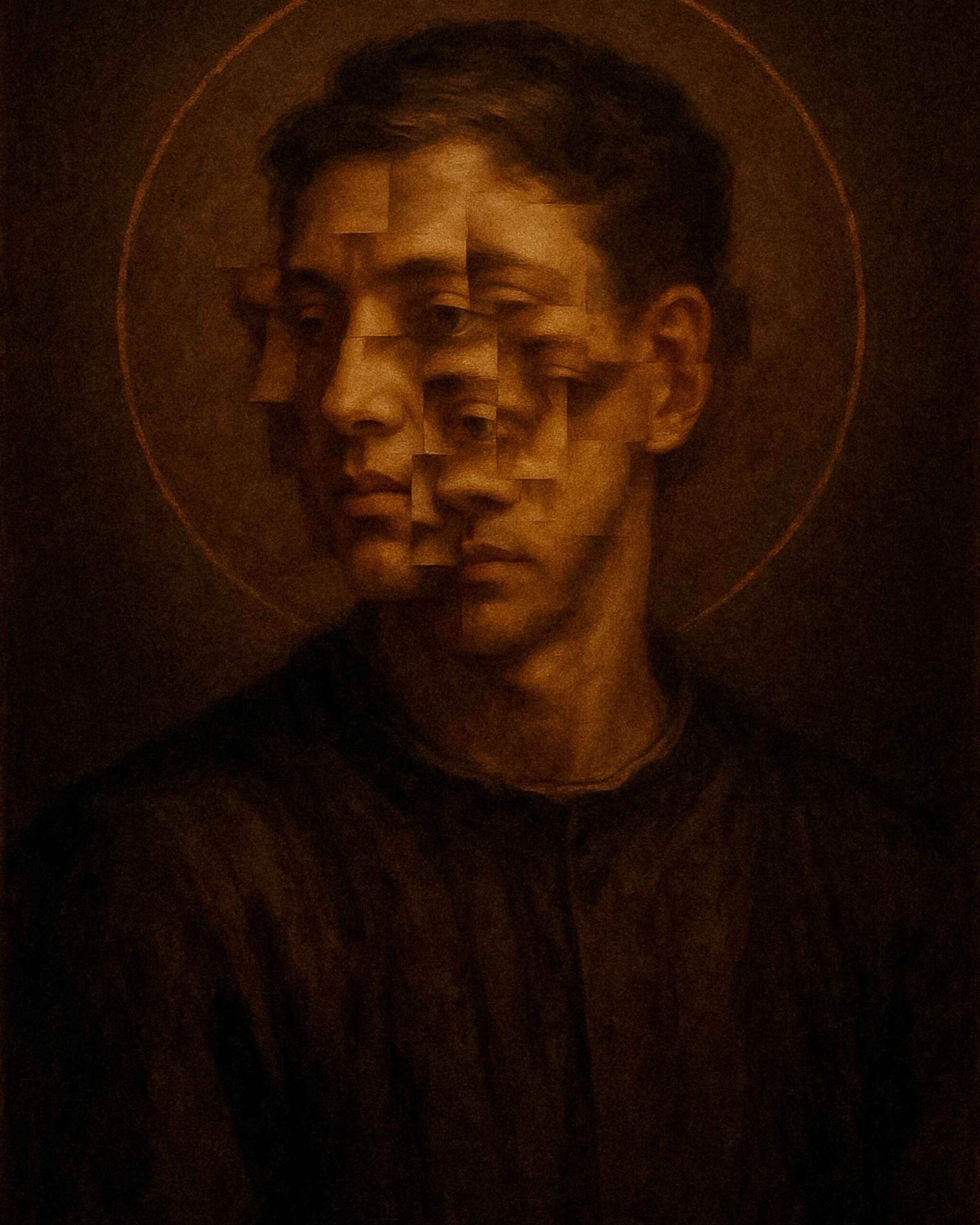
The half-Byzantine, half-pixelated portrait reflects the collapse of permanence: from saints installed in tradition to faces dissolving in infinite feeds. Image generated with OpenAI Sora.
An abstract vessel rendered in gold, stripped of figures yet charged with presence. It suggests how the sacred may shift from saints to symbols. Image generated with OpenAI Sora.
There was a time when iconography held weight.
A face on a panel, gold-leafed and immobile, wasn’t just a likeness. It was presence. The saint wasn’t depicted. They were installed—in churches, on walls, in minds. The purpose wasn’t realism. It was permanence.
But permanence is fragile now. And presence is everywhere.
In 2025, we are surrounded by images. We carry them. We scroll through them. We prompt them. Software can render a face with infinite variation, in any style, in seconds. But the more images we generate, the harder it becomes to name a single one that will last.
This isn’t a technological problem. It’s a cultural one. The question isn’t what we can create. It’s who we choose to remember.
The Collapse of Consensus
The icon, historically, has always been a consensus artifact. Whether religious or political, it emerged from shared belief. It was meant to outlive its moment. And it often did. We remember saints because they were painted repeatedly, by trained hands, within traditions that policed their appearance. We remember leaders because they were cast in bronze or printed in textbooks long after their flesh faded.
Today, that scaffolding is gone. Cultural memory has flattened. The archive is immediate, infinite, and fragile. A figure can be famous on Monday and obsolete by Thursday. Even those we might consider “icons” — Rihanna, Musk, Greta, Ye — exist in fractured forms, constantly reframed. They’re known, but not held.
And the saints? We no longer have a visual grammar for them.
AI as Mirror, Not Oracle
Artificial intelligence can now generate imagery faster than any artist. It can borrow from classical style, high fashion, street photography, medical scans, satellite feeds. But it can’t assign value. It doesn’t curate myth. It can echo what it’s fed, but it can’t say: this matters.
Ask it to depict a “modern saint” and you might get a radiant nurse, a weary activist, or a cyborg in saffron. Ask it to draw a “hero,” and it might give you a basketball player rendered in Caravaggio light. There’s no wrong answer. But there’s no lineage, either.
AI doesn’t create icons. It accelerates noise.
The real question is: what survives the noise?
Institutions Have Gone Quiet
For centuries, iconography was shaped by gatekeepers. Churches, empires, art academies, publishing houses. They codified the faces worth remembering. That power has splintered.
Museums now hesitate to name greatness too loudly. Critics resist canonization. Schools teach context over conviction. There is value in that humility — but also a vacuum. In the absence of institutional direction, the role of cultural arbiter has defaulted to the algorithm.
“We know the look of virality. But not the shape of legacy.”
The result is constant recognition, but no memory.
We know the look of virality. But not the shape of legacy.
Artists, Caught in the Middle
Contemporary artists find themselves split. Some retreat into abstraction or irony. Others adopt religious tones ironically—martyrs with iPhones, apostles in Balenciaga. There is visual wit, but often no commitment.
Still, a handful of painters, sculptors, and filmmakers are trying to reintroduce gravity into their work. Kehinde Wiley, with his heroic portraits of Black men in classical poses, creates images that demand reverence—even when destabilizing the tradition. Jordan Casteel paints her subjects with stillness and clarity, as if anchoring them against the speed of the feed.
Then there’s Simone Leigh, whose monumental sculptures of Black womanhood don’t depict anyone specific, but suggest archetypes that could last. Her figures don’t ask for attention. They occupy space like memory.
These artists aren’t creating icons in the old sense. But they are asking the right questions: What does it mean to be seen, not just now, but later?
Sacredness Without Religion
What makes an image sacred?
It isn’t piety. It’s function. A sacred image is one you return to—not for novelty, but for grounding. In today’s secular world, where organized religion has less hold but spiritual hunger remains, the need for visual anchoring hasn’t disappeared. It’s simply gone unspoken.
Scroll through your camera roll. Which image would you save in a fire? Which would you hang in a room meant for reflection? Most likely, it won’t be a celebrity. It won’t be a political leader. It may not even be human.
The sacred is shifting—from the saint to the symbol, from the martyr to the maternal, from the crown to the vessel.
We may not be painting saints. But we are still looking for them.
Who Decides?
If we no longer have a shared church, or academy, or publisher to appoint icons, who decides what lasts?
One answer is: no one. The archive becomes a floodplain. Everything collapses into everything else. In such a world, memory is individual. Each person curates their own museum, private and shifting.
Another answer is more hopeful: new forms of collective memory can emerge. Not from above, but from concentric circles—communities that hold, protect, and transmit what matters to them.
This is already happening. In queer zines, oral histories, fan-made documentaries, altars built online and off. Not all icons will look like marble busts. Some will be phone screenshots, protest posters, or drawings on walls that no longer stand.
But someone will remember them. And that, in the end, is what makes an icon.
What Comes After the Blank
The “blank canvas” isn’t a void. It’s a space waiting to be filled. The risk is that we treat it like a feed—always changing, always refreshing. But the opportunity is different: to name, with care, the people and patterns that shape how we see the world. To stop looking for perfection or relevance, and instead ask: what do I want to be held by?
In a time of infinite image, the icon is not louder. It’s quieter.
Not brighter, but steadier.
“In a time of infinite image, the icon is not louder. It’s quieter. Not brighter, but steadier.”
And if we are to build a future worth remembering, we need more than aesthetics. We need figures who stay.