The New Obsession: Handmade Everything
At a moment when almost anything can be ordered, delivered, and unwrapped within hours, a particular kind of person is turning elsewhere. Not out of rebellion, and not to make a scene. They are stepping back, choosing work shaped by hands, not systems.
From tailoring to perfumery, from blades to shoes, and even within the industrial heart of watchmaking, the objects now most coveted by connoisseurs are not algorithmic suggestions or hyped releases. They are made slowly, in small rooms, by individuals who rarely advertise and who almost never expand. Scarcity here is not an afterthought. It is the foundation.
These makers share less in aesthetic than in pace. They work in rhythms set by cloth, by fire, by wood or steel, not by production schedules. What results is more than a product. It is a pattern of consumption that feels private, often invisible.
The Neapolitan Constraint
Antonio Panico does not run an e-commerce platform. He does not need to. The former head cutter at Rubinacci, shaped by Naples’ great tailoring lineage, now works quietly, one suit at a time. He sees clients by appointment. He cuts with patience, and he refuses to be hurried. His jackets are soft yet composed, elegant yet designed for real life. The price is not the point. The point is presence.
Other Neapolitan houses operate in much the same way. Sartoria Dalcuore, Sartoria Ciardi, and Sartoria Formosa maintain workshops where jackets take months, sometimes longer, to leave the bench. There are no campaigns, no media buys, no diffusion lines. Just fabric, shears, and hours.
“There is nothing to grow. I make what I can. That is enough.”
One tailor, when asked why he never thought of expanding, shrugged. “There is nothing to grow. I make what I can. That is enough.”
The Knife That Takes a Year
In Takefu, Japan, Takeshi Saji forges knives and razors that carry forward three generations of craft. Each blade is shaped in fire, cooled with care, and finished entirely by hand. Handles are made from stag antler or rare woods. The Damascus steel never looks the same twice.
Saji’s knives are neither inexpensive nor quick to arrive. Some orders take close to a year, though simpler pieces can appear sooner. Collectors know him well, but his name is absent from the churn of trend cycles. In a culture of instant dispatch, his waiting list functions as a sieve. It selects only those prepared to slow their expectations.
“His waiting list functions as a sieve. It selects only those prepared to slow their expectations.”
The Return of the One-Person Shoe
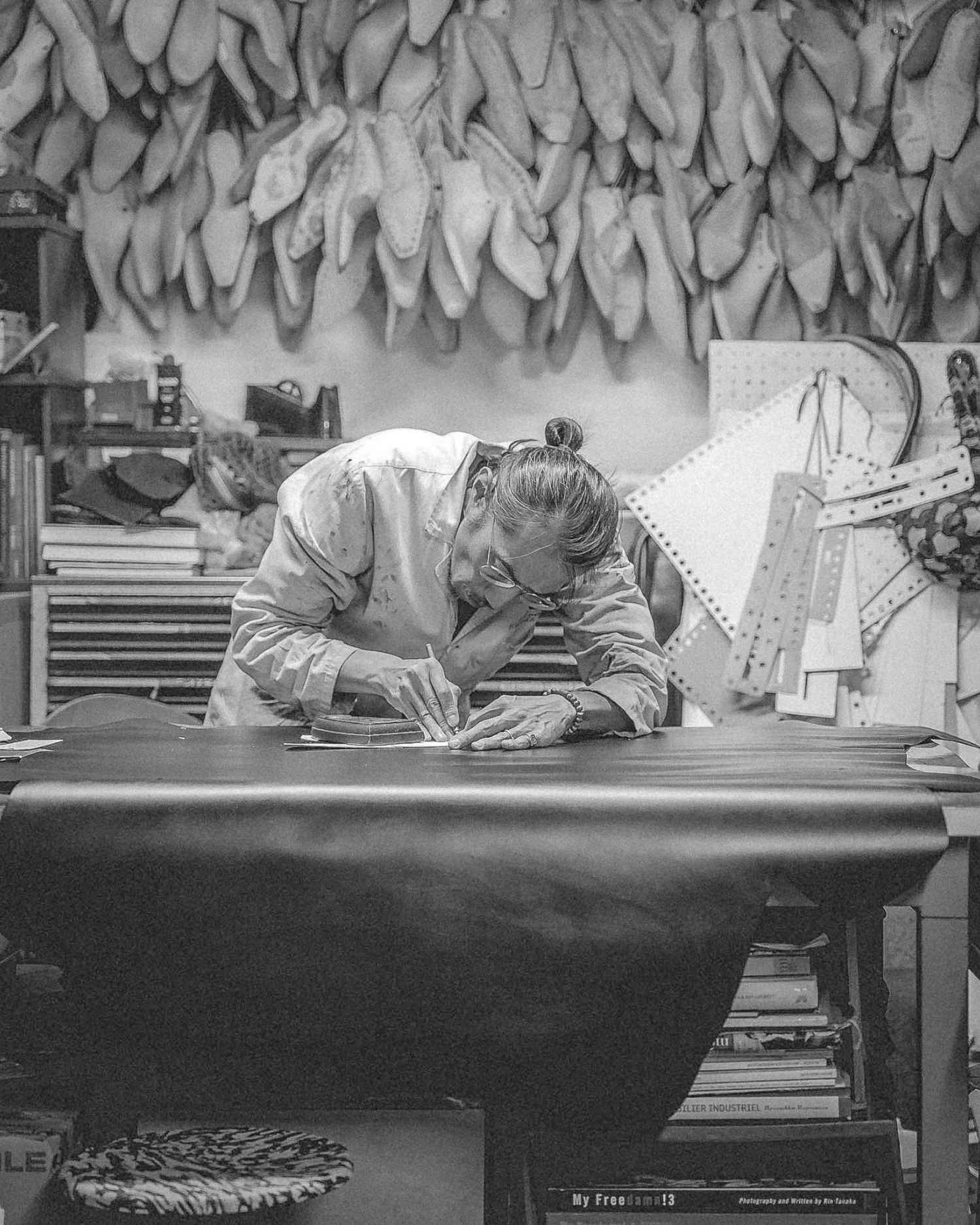
In Florence, Hidetaka Fukaya, known as Il Micio, makes shoes for a very small circle of international clients. A Japanese shoemaker who studied in Italy before opening his atelier, Fukaya is known for silhouettes that feel sculptural, almost feline—low to the ground, closely lasted, unmistakably shaped by hand.
There is no storefront. There is no sales team. Orders are placed through correspondence or in person. A pair can take months to complete. Those who commission them rarely discuss them publicly. They do not have to. The shoes communicate in detail, not volume.
Perfume That Refuses Scale
In Berkeley, California, Mandy Aftel blends perfumes from natural essences she sources and distills herself. She has been at it for decades, long before “indie perfume” was a phrase, working at a scale so small it feels closer to a studio practice than to business. Many of her releases number only a few dozen bottles. Ingredients shift with each harvest. A formula may never return.
Aftel is not alone. Dawn Spencer Hurwitz in Boulder, Josh Meyer of Imaginary Authors in Portland—these perfumers treat scent as narrative, as moment, not as product line. Their compositions do not fit seasonal launches or mass distribution. Sometimes the best blends live only once.
“People ask for the same perfume again,” Aftel has said. “But the raw materials change. The air changes. The story has already been told. Why repeat it?”
Timepieces That Are Not Watches
Even in the historically industrial world of horology, the handmade ethos has become central.
In Tokyo, Naoya Hida left corporate watchmaking in 2019 to form Naoya Hida & Co. His annual output is around 20 to 30 pieces, each modeled on the clean proportion of pre-war wristwatches, executed with meticulous finishing. His cases are hand-polished, his dials hand-engraved, and his movements assembled in small Japanese workshops. There are no collaborations, no novelties. Just variations on a single clear idea.
In Geneva, Rexhep Rexhepi of Akrivia has become the reference point for a new generation of independent haute horology. Every detail, from hand-guilloché dials to the most hidden angles of the movement, receives obsessive attention. His books are often closed. Waiting periods can last years. Clients continue to wait.
“If I make more, I lose what makes it mine.”
Asked why he never raises production, Rexhepi answered plainly: “If I make more, I lose what makes it mine.”
The Handmade Code
“A handmade object does not attempt to impress at first glance. It waits for you to notice.”
This turn toward the handmade is not a passing trend. It is a language. It speaks through visible stitching, through the slight irregularity of grain, through surfaces touched again and again until they feel finished. A handmade object does not attempt to impress at first glance. It waits for you to notice.
Part of the appeal lies in limitation. Not every atelier takes new clients. Some close their books for years. Others work only with long-standing patrons. This is not about exclusion. It is about clarity—the understanding that scale erodes both quality and meaning.
Those who move in this world do not ask for discounts. They do not expect speed. They understand that value resides partly in the waiting.
What This Means
Handmade does not mean rustic. It does not mean nostalgic. It means that an object has passed through gestures, revisions, and time. It has absorbed presence.
The people drawn to these objects are not signaling wealth. They are signaling a different relationship to ownership. To have fewer things, each made slowly and kept for long stretches of life, is not a deprivation. It is a form of abundance.
In the end, it is not about having less. It is about finding enough.