Desert Modernism, Reheated
There’s a kind of architecture that doesn’t photograph easily. It sits low. It doesn’t gleam. It doesn’t try to impress. But once you’ve moved through it—its shadows, its weight, its stillness—you remember exactly how it felt.
That’s the kind of modernism emerging from western Rajasthan.
Not in Jaipur’s polished boutiques or Udaipur’s lakeside courtyards, but in and around Jaisalmer, where the land flattens and the heat becomes spatial. In this transitional zone, part village and part testing ground, a new generation of architects is shaping desert buildings that don’t borrow from California. They draw from silence, stone, and sunlight, without apologizing for being severe.
The Desert Demands Its Own Logic
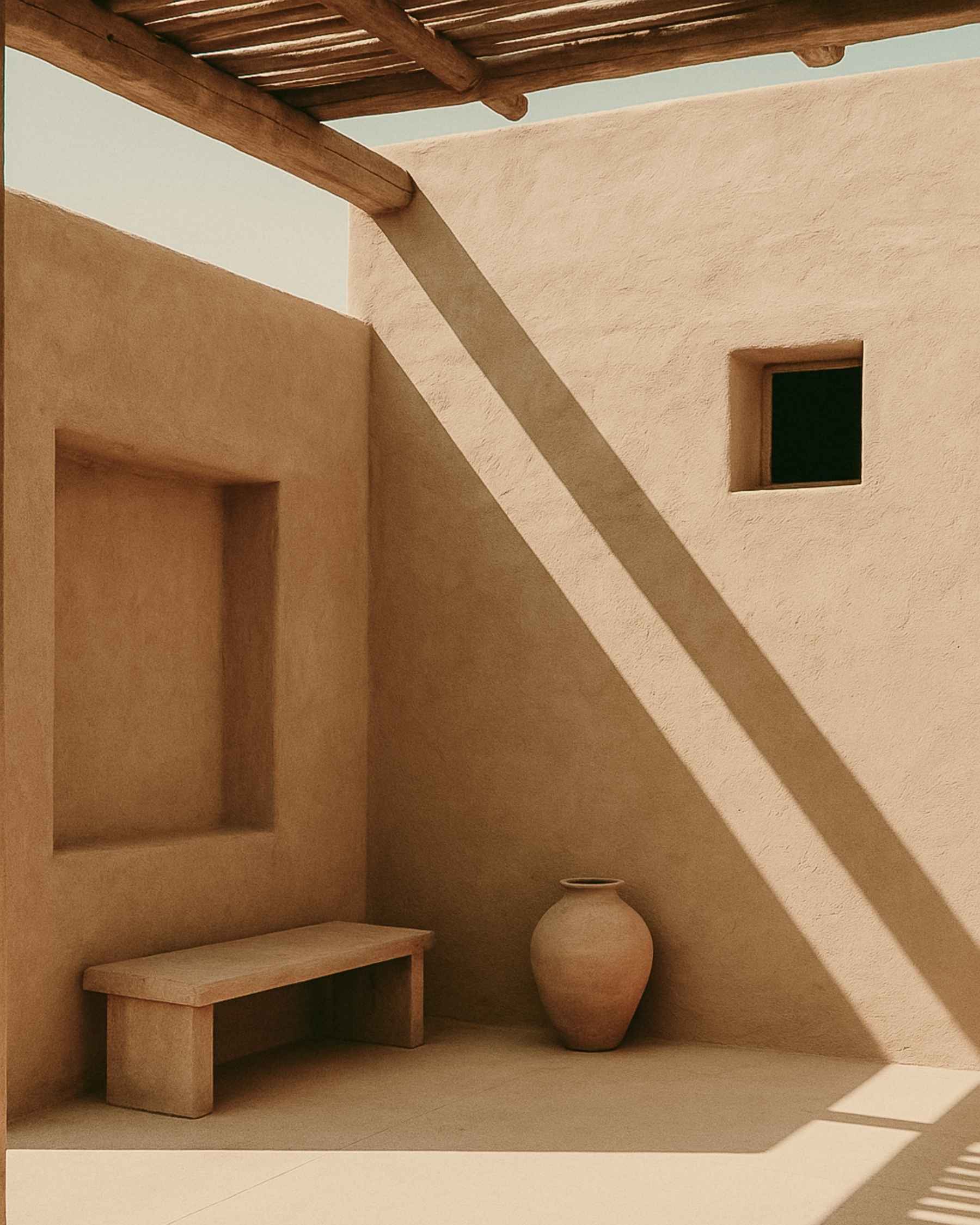
Classic desert modernism conjures Palm Springs: crisp overhangs, cantilevered pools, martinis in the shade. That vision doesn’t hold here. Rajasthan’s Thar region forces a different kind of architecture—heavier, deeper, mineral rather than glass. Light isn’t admitted, it’s filtered. Heat isn’t defied, it’s absorbed and slowed.
Where American desert homes once floated above the ground, these new structures anchor themselves. Thermal mass matters. Rooflines stay low. Ornament gives way to weight. Brutalism, in this context, isn’t aesthetic, it’s practical.
“Light isn’t admitted, it’s filtered. Heat isn’t defied, it’s absorbed and slowed.”
The School in the Desert — Dharmesh Jadeja, Hunnarshala Foundation
Near Bhadariya, far from gridlines and cities, sits a school that seems to have emerged from the land itself. Designed by architect Dharmesh Jadeja with the Hunnarshala Foundation, it is built from stabilized earth and sandstone, materials that shift subtly with light and season. The building doesn’t compete with the landscape, it continues it.
Courtyards serve as classrooms. Verandas are deep, shaded, and directional. Wind passes cleanly through channeled apertures. Solar panels line one side of the roof, angled not for show but for efficiency. Students sit on handmade mats. The temperature inside remains stable even when the desert outside moves past 45°C.
“The building doesn’t compete with the landscape, it continues it.”
There is no air conditioning. There are no false ceilings. The design doesn’t accommodate modern expectations, it rewrites them.
What makes the project significant isn’t just its off-grid intelligence, but its refusal to exoticize. There’s no decorative apology for minimalism, no attempt to smooth the edges. This is what learning looks like in a place where silence teaches as much as speech.
Studio Sangath — Riyaz Tayyibji
Riyaz Tayyibji, principal architect at Studio Sangath, approaches desert architecture not as a stylistic exercise but as a condition. His firm has worked on several projects across Rajasthan and Kutch that treat heat as a spatial collaborator.
One such project, a rural learning center in Barmer, is shaped around shaded thresholds and internal courtyards. The palette: lime plaster, earthen bricks, reclaimed wood. Nothing is flat-packed or outsourced. The building adjusts to its occupants rather than the other way around.
Tayyibji draws from vernacular precedents—stepwells, shaded plinths, wrapped balconies—not to mimic them but to understand how they endured. His buildings don’t pose for architectural press. They invite long stays.
Art, Residence, and the Return to Constraint
Beyond institutional work, a smaller network of artists, ceramicists, and writers is establishing outposts in and around Osian, Pokhran, and the peripheries of Bikaner. Some are working with compressed stabilized earth blocks. Others restore abandoned farm compounds using limecrete and solar tiling.
One such compound hosts short-term residencies capped at four guests. There’s no WiFi. Power comes from roof-mounted panels. Nights are lit by lanterns or not at all. The plan includes a shared kitchen, a reading room, and four east-facing cells open to the wind.
The idea, the host explains, is not to simplify life but to remove friction between thought and setting. “You don’t need much to work,” he says. “Just walls that don’t push you out.”
Material as Memory
What ties these projects together is their deference to local material logic. Sandstone, lime, mud, camel-dung plaster—these aren’t rustic touches. They are structural decisions. Chosen not just for heritage but for how they age, regulate heat, and return to the earth without residue.
Color, too, is drawn from what is already present. There is no stark white. Interiors are dusky, warm, close to shadow. Finishes aren’t polished. They are matte, chalky, absorbent. Light doesn’t bounce. It rests.
Acoustic Architecture
The thickened walls, sunken courtyards, and open-roof passages serve more than thermal needs. They manage sound.
Unlike urban minimalism, which echoes, desert modernism here is tuned to muffle. Footsteps dull. Voices flatten. Wind becomes part of the composition. Sound isn’t trapped, it is spaced. This acoustic subtlety—rarely documented—is central to the experience. Time stretches differently in buildings that don’t speak over you.
Solar as Default
In all of these projects, solar power is integrated quietly. Not as a flourish or virtue signal, but as baseline infrastructure. Panels are often invisible from approach. Batteries are housed in mud-walled sheds. Systems are minimal—lighting, basic cooling, water filtration.
There’s no attempt to recreate grid behavior. Instead, the architecture asks less of the environment and offers just enough in return.
What Desert Modernism Means Now
This isn’t a movement built for visibility. Some architects don’t name their projects. Some residents ask for no photography. Many buildings don’t announce their authorship. That’s not humility, it’s calibration.
Jaisalmer’s new desert thinkers aren’t making statements. They’re making decisions. While the architectural world still centers around renderings and rooftop pools, here in the Thar something else is taking shape: a style defined by shadow, solar rhythm, and materials older than the plan.
“Jaisalmer’s new desert thinkers aren’t making statements. They’re making decisions.”
Not Palm Springs. Not Dubai. Not nostalgia.
Just buildings that stand until the wind decides otherwise.